Chapter 2
Do Something!
Juerdon
The wheat of Haldmark had stopped being wheat. It was now a sort of golden suggestion of wheat, thin and dry and bent, rustling in a hot wind that came from nowhere and went nowhere.
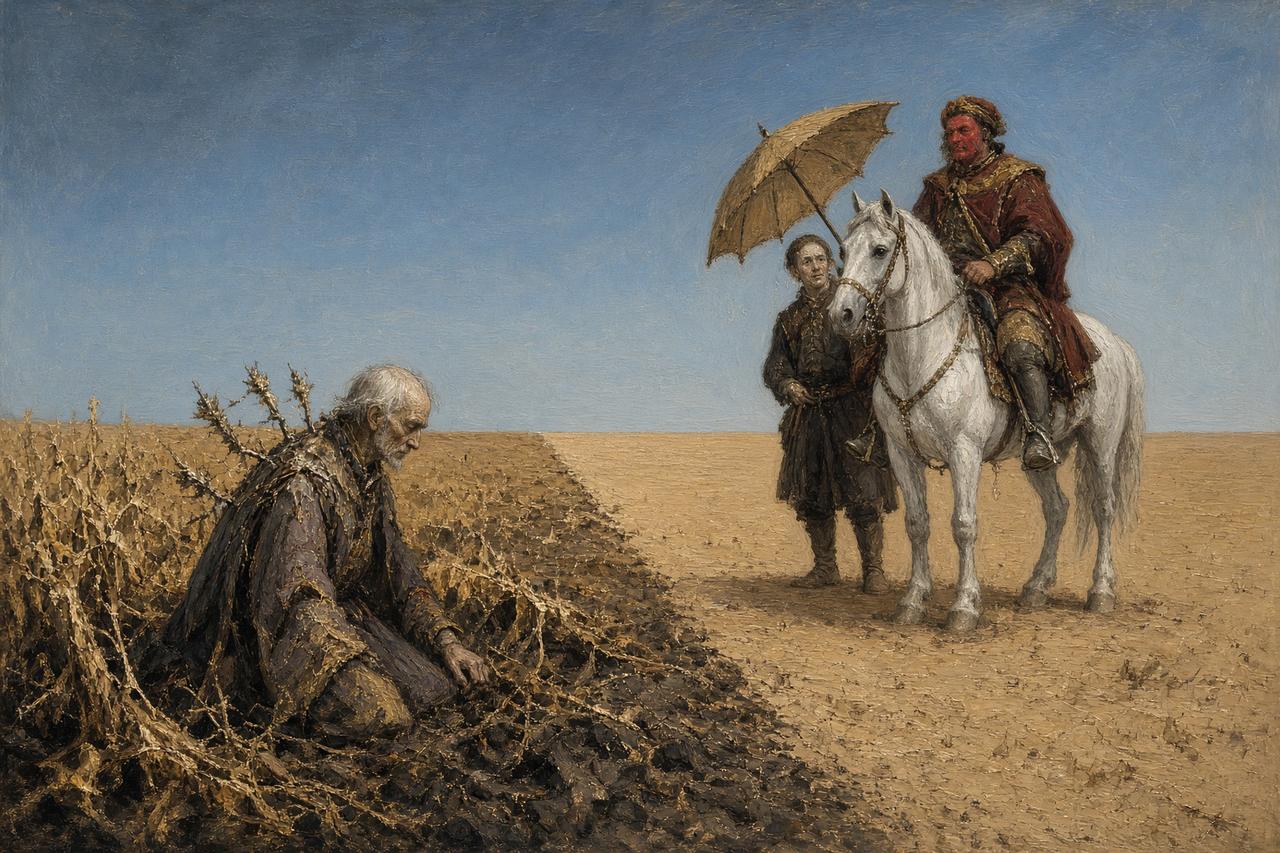
Archmage Juerdon knelt in the middle of a field and put his hand flat on the soil.
It was warm. Too warm. It crumbled under his palm like old bread. He closed his eyes and let his mind sink into it, the way he had been taught sixty years ago, when he was young and stupid and still had all his hair.
There. Under the soil. A thread of magic, thin as a spider's silk and hard as wire. It ran through the field and out into the next field and the next, all the way to the horizon. Wherever it ran, the water fled. The clouds above Haldmark broke up and drifted away like guests leaving a dull party.
Drought.
Not a natural one. Natural droughts did not have edges. This one had edges, clean ones, as if somebody had drawn a line around the realm with a ruler.
"Archmage!"
Juerdon sighed and opened his eyes.
Lord Vaeric was coming down the road on a white horse. The horse was very fine. The Lord was less fine. He was a broad, red man in a green coat, with a beard that had been oiled into curls and a crown that sat a little too far back on his head, like a boy wearing his father's hat. Behind him rode six knights, two clerks and a man whose only job was to hold an umbrella over the Lord when the sun got too strong.
The sun was strong. The umbrella man was sweating.
"Archmage," said Vaeric again, reining in at the edge of the field. "Look at this. Look at it!"
"I am looking at it, my Lord."
"It's dead!"
"It is not well."
"It's dead, Juerdon. The wheat is dead. The barley is dead. The cows are looking at me like I owe them money." Vaeric waved his arm across the dying plain. "This is Haldmark! We feed the alliance. The halflings eat our bread. The minotaurs eat our bread. Even that ridiculous chef in Korrun puts our flour in his desserts. If Haldmark fails, everyone fails."
"I am aware, my Lord."
"Then why are you kneeling in the dirt like a peasant?"
Juerdon stood up. His knees cracked like dry sticks. He was seventy-nine years old and he had fought nightspawn at Tereb Bluff, and his knees had never forgiven him for either.
"Because the answer is in the dirt," he said.
Vaeric leaned forward in his saddle. For a moment he looked almost hopeful. That was the worst thing about Vaeric. He could be a fool and a bully and a coward, but he loved his fields. He really did.
"If the weather doesn't turn soon," he said, "this drought will end us. Do something!"
Juerdon looked up at the sky. It was a hard, empty blue.
"Very well," he said.
* * *
He did it properly. He owed the wheat that much.
He stood in the centre of the field and spread his arms. He reached up, past the hot air and the broken clouds, into the high cold places where the weather is made. He gathered moisture from the far sea. He shaped it, thickened it, called it down. It was Rain, the old spell of the Nature realm, and he had cast it a thousand times. Rain fed the crops. Rain lowered morale a little, because nobody likes to be wet, but it fed the crops.
The sky darkened. Clouds came in from the west, grey and heavy. The knights looked up. The umbrella man looked up with real joy.
The first drop fell. It hit Juerdon on the nose.
Then the thread under the soil pulled tight. He felt it like a hand closing on his wrist. The clouds shivered. They thinned. They broke apart into pale rags and blew away towards the east, and the sky was blue again.
Rain was countered by Drought. Every apprentice knew that. But Drought did not usually win so easily against an archmage. Not unless the caster was very strong. Or very determined. Or both.
"Well?" said Vaeric.
"My Lord," said Juerdon, "someone is doing this to you on purpose."
"Of course someone is doing this on purpose! Who?"
Juerdon didn't answer. He knelt again and put both hands on the soil, and this time he went deeper. He followed the thread of the spell back through the earth, not outwards but inwards, to its heart. Every spell carries the mark of the one who cast it. It also carries the mark of the tool. A staff leaves one kind of mark. A ring leaves another. A wand leaves a third.
This was a wand. He could feel its shape. Old. Cheap. Badly made. The charge in it was long gone, so it was not the wand's own power doing this. It was only a focus, a lens, but a lens with flaws, and the flaws were in the spell. There was a little wobble in the magic, a crooked place, as if a child had carved a groove into the wood with a knife.
Juerdon's breath stopped in his chest.
He knew that groove. He had carved it himself, sixty years ago, in a cold room above the Sunken Cathedral, by the light of one candle, because he had been too poor to buy a proper wand and too proud to admit it. He had carved two letters into the handle. One was his. One was hers.
Then he had given it away.
"Archmage?" said a clerk. "Are you ill?"
"No," said Juerdon. He stood up slowly. "No. I am only old."
* * *
They rode back to Ballaruk in the afternoon. The city sat on its hill above the plain like a fat man at a table. Three rings of walls. Guard Towers at every corner. Granaries, Vaults, a Coliseum where the people watched fighters and drank beer and forgot about the price of bread. Ballaruk had never fallen. Lord Vaeric reminded everyone of this at least twice a day.
Today he did not mention it. He sat in his council chamber with his crown on the table and his head in his hands.
"Numbers," he said.
The first clerk read them out. Food stored. Food produced. Food consumed. The numbers went down and down, like a man falling down a long stair.
"If nothing changes," said the clerk, "the granaries will be empty in forty turns."
"Forty."
"Thirty-five, my Lord, if the halflings keep coming to dinner."
Vaeric lifted his head. His eyes were red.
"Then we ration," he said. "Everyone. Half portions. No feasts. No festivals." He paused. "No desserts."
"The minotaurs will not like that, my Lord."
"The minotaurs can eat grass. They're half cow."
"They are half bull, my Lord, and they are very sensitive about it."
Vaeric ignored him. He turned to Juerdon, who stood by the window watching the empty sky.
"Juerdon. If we ration, how many farms do we need?"
Juerdon thought about it. If the people ate less, the land needed less. And there was a spell for that too. Fasting, from the Life realm. With Fasting, one mana could cover the food of twenty-five people. It could cut the hunger of a whole kingdom by a third.
"Fewer," he said. "Perhaps a third fewer."
Vaeric slapped the table.
"With the new rationing in effect," he said, "we don't need as many farms. Commission more Mage Towers."
The clerks wrote it down. The knights nodded wisely. Only Juerdon understood how mad it was. Tear down the farms in a drought. Build towers to make the mana to cast the spell that let you need fewer farms. It was like selling your boots to buy a horse because your feet hurt.
But it would work. For a while. In Vaeric's world, everything worked for a while.
"And the drought?" Vaeric asked. "Who is casting it?"
Juerdon turned from the window.
He could lie. He was good at lying, in the way that all court mages become good at it. You did not survive forty years in Vaeric's service by telling him everything you knew.
"High Elves," he said. "The magic has the taste of Aerithil."
The room went cold.
"Valadriel," said Vaeric.
"Very likely."
"That witch." Vaeric stood. He began to walk up and down the long table. "That cold, beautiful, murdering witch. She wants to starve us. She wants to break the alliance by breaking the belly." He stopped. "Can you kill her?"
"No, my Lord."
"Can you break the drought?"
"Not from here. Not while she holds the focus."
"Then what good are you?"
Juerdon said nothing. In forty years he had learned that this question did not need an answer. It only needed time to pass.
Vaeric sat down again. He put his crown back on. It slid a little to one side.
"Send an envoy to Aerithil," he said. "We'll talk. We'll offer something. Peace for a week. A trade. Anything. Buy time." He looked at his clerks. "And find out where my scouts are. The ones we sent to Nethrask. They should have been back three turns ago."
"Yes, my Lord."
The council broke up. The knights went to drink. The clerks went to count things. Juerdon climbed the long stair to his own tower, where the windows looked east towards the hills of Aerithil, and he did not light a candle.
He sat in the dark and thought about a cheap wand with a crooked groove.
He thought about a girl with silver eyes, sitting on the steps of the Sunken Cathedral and laughing at him, because he had tried to cast Bless on a moth and the moth had exploded. He thought about the night she said she would never be queen. He thought about the morning she was crowned.
She had kept it. All these years. Through the crowning and the wars and the long cold silence. She had kept the wand.
And now she was using it to starve his people.
Juerdon put his face in his hands. He was not sure if he wanted to laugh or to weep. In the end he did neither. He was too old and too tired, and the night was too hot for tears.
Outside, very far to the east, a single cloud tried to form over the hills. It lasted a moment. Then it broke apart and was gone.