Chapter 4
Where Is All the Hell-Damned Food?
Kruktchek
Orcs are never happy. That is the first thing every orc child learns, usually from being hit by an older orc child. It is also the thing that makes them hard to command. When your army is always miserable, you cannot tell when it is getting more miserable.
High Shaman Kruktchek could tell. He could always tell. It was his job.
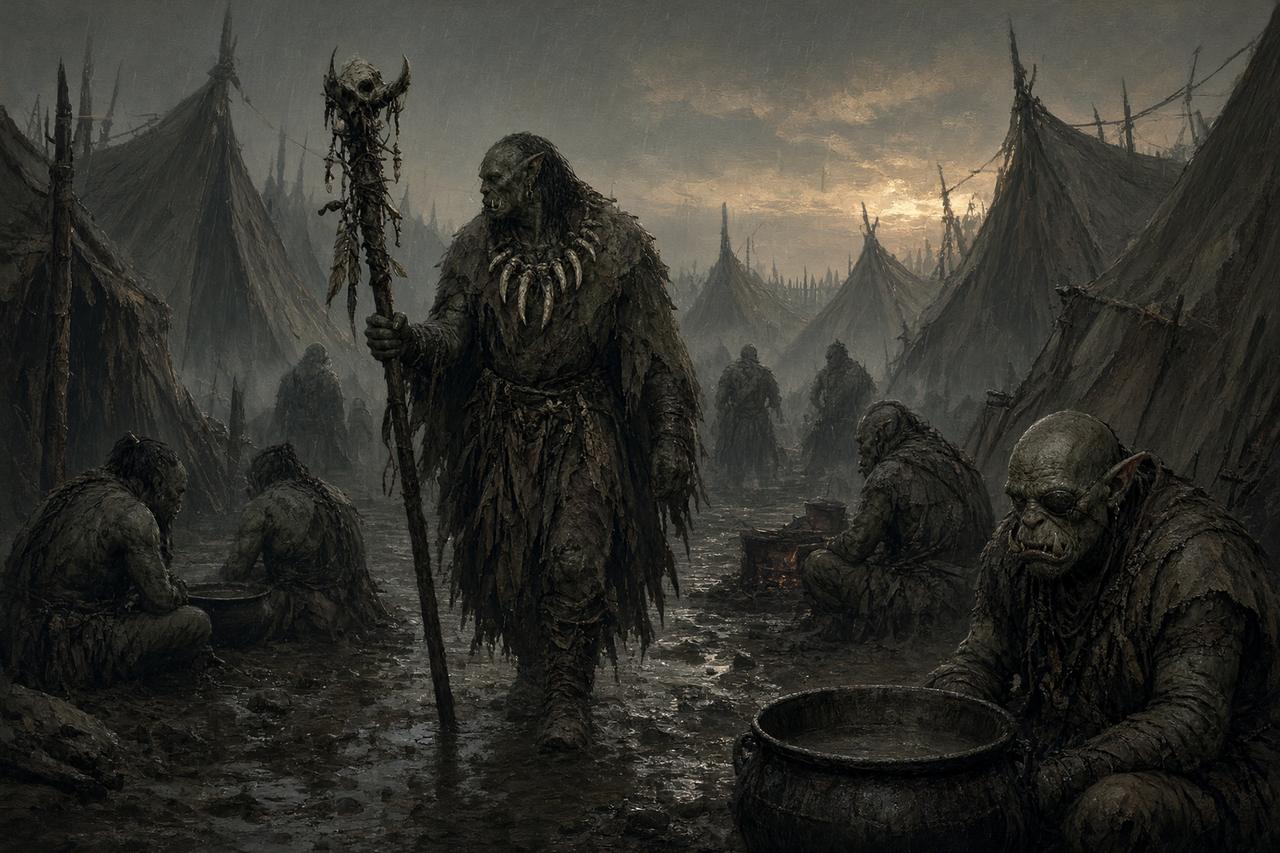
He walked through the war camp of Grashnak at dawn with his staff of bone and his necklace of teeth. Mud sucked at his boots. The tents sagged in the drizzle. Around the cookfires, orcs sat in silent rows and stared at the empty pots. Nobody fought. Nobody sang the old songs about cracking skulls. Nobody even complained.
That was bad. When orcs stopped complaining, something was very wrong.
"Shaman," said an old warrior by the fire. His name was Ugrash. He had one eye and three teeth and a voice like gravel in a bucket. "Shaman, my grandson ate his boot."
"Was it a good boot?"
"No. That's why I'm worried."
Kruktchek crouched by the fire. He put his hand on the ground, as he always did. Orcs were not great mages. The Gutlands were not a place where scholars grew. But every orc tribe had a shaman, and every shaman could feel the land, and Kruktchek could feel it now.
It was sick.
Not the soil. The soil was fine. Muddy and grey and full of worms, the way good orc soil should be. The sickness was in the food. Everything that grew here, everything that was stored in the pits and the sacks and the smoking sheds, was being eaten by something invisible. A quarter of the stores gone in one night. Half the harvest wilting in the field.
Famine. A spell of the Death realm. Undispellable. Ten turns of it, maybe more. It made troops weak, and it made granaries empty, and it made old warriors watch their grandsons eat boots.
"Ugrash," said Kruktchek, standing. "Tell the boy to stop eating his boots."
"What should he eat instead?"
Kruktchek looked across the camp. Beyond the tents, in the grey morning light, the slave pens stood. Goblins, mostly. A few humans. Some orcs who had lost their tribe or their courage or both.
He looked away.
"Wait," he said. "Just wait."
* * *
Chief Gragzul's tent was the biggest in the camp. It was made from the skins of three elephants and one very unlucky giant. Inside it was hot and smoky and smelled like old blood and new sweat.
Gragzul sat on a throne of wargs' skulls. He was huge, even for an orc. His tusks were capped with iron. His arms were like oak trunks. His head was like a smaller oak trunk with eyes, and the eyes were small and red and very angry.
"Kruktchek!" he roared, before the shaman was even through the flap. "Where is all the hell-damned food!?"
Kruktchek bowed. Not too low. You never bowed too low to Gragzul. He took it as a sign of weakness and sometimes he stepped on your head.
"Gone, Boss."
"Gone where?"
"Eaten, Boss."
"By who?"
"By magic."
Gragzul stood up. The skulls of his throne rattled. He came across the tent in two strides and grabbed Kruktchek by the necklace of teeth.
"Then use magic," he said, "and get it back."
"It doesn't work like that, Boss."
"Make it work like that!"
Kruktchek waited. He had served Gragzul for eleven years. Gragzul had killed two shamans before him. One for being too slow. One for being too clever. Kruktchek had survived by being exactly as clever as he needed to be, and not one bit more. At least, not out loud.
"Boss," he said carefully. "There is the old way."
Gragzul's eyes narrowed. Slowly, his grip on the necklace loosened.
The old way. Every orc knew it. Bloodlust. Orcs and ogres both had the gift. When the food ran out, you took it from the people. The weak, the old, the useless. The slain became food. And the warriors who ate it became wild, strong, terrible. Bloodlust doubled the damage of combat troops on attack and on defence. It made an orc army into a storm of teeth.
It also killed your own people every turn it was active. That was the price. Bloodlust was not a spell you cast. It was a spell you paid for.
"The old way," said Gragzul, and he smiled.
"Only for a few turns, Boss. Until the Famine passes."
"Do it."
"Boss, the warriors will be strong, but the camp will..."
"I said do it!"
Kruktchek bowed again. He walked out of the tent into the rain.
He stood in the mud for a while and looked at the slave pens. Then at the old warriors by the fires. Then at the grandson, who had found another boot.
"Feel nothing but the hunger," he said quietly, which was the old prayer. He didn't believe in prayers. But it seemed right to say something.
Then he raised his staff and began the chant.
* * *
That night the camp ate meat.
Nobody asked what meat. Orcs do not ask. That is the second thing every orc child learns.
Kruktchek did not eat. He sat in his own tent, which was small and leaked, and he looked into a bowl of dark water. It was not proper Scrying. He was not that kind of mage. But a shaman could see a little in still water, if he was patient, and Kruktchek was always patient.
He looked for the caster of the Famine.
It was hard. The spell was old and cold and well hidden. Whoever cast it had wrapped it in shadow, so that its source was blurred like a face behind smoked glass. But Kruktchek had a trick. Every caster leaves a taste in their magic. Humans taste of salt. High Elves taste of cold stars. Gnomes taste of wet earth and festival beer.
This one tasted of black wine. Of mushrooms grown in caves. Of a temple to a goddess who smiled too much.
Dark Elves.
Kruktchek sat back on his heels. His tusks clicked together, the way they did when he was thinking.
Why would Dark Elves curse the Gutlands? Sarrson's kingdom was far to the north and east. Sarrson had never troubled the orcs. Sarrson's war was with Vaeric, everyone knew that, and with the High Elf queen, and with the rats in his granaries.
Unless Sarrson wanted the orcs hungry. Unless he wanted them desperate.
Unless he wanted them to say yes to something.
There was a noise outside. Shouting. Kruktchek stood up and pushed through the flap.
A rider had come into the camp. Not an orc. A dark elf, thin and dressed in black, on a black horse with silver eyes. Six orcs surrounded him with spears. He did not look afraid. He looked bored.
"I come from the Lord of Nethrask," he said in a high, clear voice. "With a message for the Chief of the Gutlands."
* * *
Gragzul received him on the throne of skulls. Kruktchek stood at his left shoulder. The tent was full of warriors, all of them chewing, all of them with that red light in their eyes that came from Bloodlust.
The dark elf did not seem to notice the smell. He bowed low. He bowed so low that Gragzul looked pleased.
"Great Chief," said the envoy. "My Lord Sarrson sends greetings, and sorrow. He has heard of your hunger."
"How?" said Kruktchek.
The envoy did not look at him.
"My Lord knows many things," he said to Gragzul. "And he knows this. The land is broken. The Mad God laughs at us all. The old kingdoms are gone, and the new ones fight like dogs over bones. Vaeric of Haldmark sits on the best farmland in Nova. He grows fat. He feeds his halflings and his minotaurs and his merchants. And here you are, Great Chief, eating..."
He paused. He looked at the meat in the pots.
"Eating what you must," he finished.
Gragzul grunted.
"My Lord proposes an alliance," said the envoy. "The Dark Elves and the Orcs of the Gutlands. Your strength. Our magic. Together, we will take Haldmark. Its grain will feed your camps. Its lands will be yours. My Lord asks only for the castle at Ballaruk and the High Elf queen's head."
The warriors muttered. Some of them grinned. Gragzul leaned forward on his throne.
"What do we get first?"
"Food," said the envoy. "My Lord will send Create Food. Fifty turns of it, from his Mage Towers. And when the war is won, more food than you can eat."
"I can eat a lot of food."
"My Lord is aware."
Kruktchek felt his tusks click again. Create Food. Of course. Create Food countered Famine. Sarrson had made the orcs hungry, and now Sarrson was offering to feed them. It was like a man who poisons your well and then sells you water.
"Boss," he said quietly. "A word."
Gragzul waved a hand without looking at him.
"Not now."
"Boss, this is important."
"I said not now, Kruktchek!"
The envoy looked at the shaman for the first time. His eyes were pale violet, like the glass of a temple window. He smiled very slightly. It was the smile of a man who has read the last page of a book and knows how it ends.
"Your shaman is wise to be careful, Great Chief," he said. "But my Lord's words are simple. Together, we could crush this land. Alone, we will both be eaten by it."
Gragzul slammed his fist on the arm of his throne. A skull cracked.
"Done!" he roared. "Tell your Lord the Orcs of the Gutlands march with him! Tell him to send the food! Lots of food! And tell him Gragzul wants the elf queen's head too, for a drinking cup!"
The warriors roared. The tent shook. Somebody started to bang a shield. In a moment the whole camp was howling, the red Bloodlust light in every eye.
The envoy bowed and backed out of the tent.
Kruktchek followed him. He caught up with him at the edge of the camp, where the black horse waited in the rain.
"You cast the Famine," said Kruktchek. "Your Lord did. I tasted it."
The envoy swung up into the saddle. He looked down at the orc shaman. He did not deny it.
"Does it matter?" he asked.
"It matters to the boy who ate his boots."
The envoy thought about this. For a moment he seemed almost sad.
"Shaman," he said. "In a war like this one, the only thing that matters is who is still eating at the end."
He turned the black horse and rode away into the dark.
Kruktchek stood in the rain for a long time. Behind him the camp was singing again, at last. They were singing the old songs about cracking skulls. In the middle of the song somebody screamed, and then the screaming stopped, and the song went on.
The High Shaman of the Gutlands went back to his leaking tent. He looked into his bowl of dark water. He saw nothing.
But he made a promise to himself. One day Lord Sarrson would learn that he did not have a monopoly over cleverness.
Or over the stealing of anything.